


I keep thinking about a verse lately:
"The glory of this present house will be greater than the former…" — Haggai 2:9
A lot of churches, ministries, and leaders are in a rebuilding season right now. Reevaluating. Restructuring. Trying to discern what God is doing next. And in seasons like that, it's easy to romanticize the past — old models, former growth, what once felt easier.
But I don't believe God is asking the Church to recreate the past. I believe He's inviting us to faithfully build the future He is preparing.
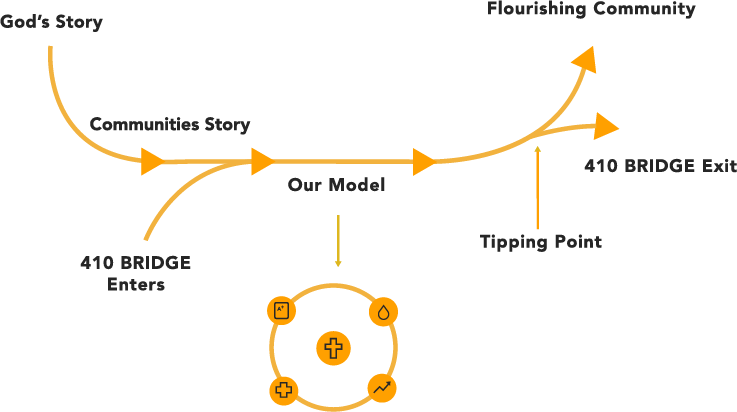
At 410 Bridge, that conviction shapes everything — including a simple picture we call A Shared Story. It holds everything we believe about how lasting transformation happens. Let me walk you through it.
It starts with God's story
The line at the top of the graphic doesn't begin with us. It begins with God's story — the story He's been writing since the beginning, in every nation and every community on earth.
That matters more than it might seem.
When we enter a community, we're not bringing God there. He's already at work. Long before 410 Bridge arrives, God is moving through local churches, leaders, families, and relationships.
Our job isn't to arrive with all the answers. It's to recognize what God is already doing and ask how we can come alongside it.
That changes our posture from the very beginning.
Before we act, we listen. Before we lead, we learn. And before we decide what a community needs, we seek to understand what God is already doing there.
Every community has a story of its own
Flowing out of God's story is the community's story.
Long before 410 Bridge shows up, every community we serve has a history, a culture, relationships, local leaders, and a God-given capacity to flourish.
That's why we don't see communities as problems to be solved. We see them as stories already in motion — with strengths to build on, gifts to be recognized, and people who understand their community in ways we never could.
Our role begins with recognizing what's already there, not simply identifying what's missing.
At the heart of many of these communities is the local church. We believe the local church can be one of the most transformational forces in a community — developing leaders, discipling people, restoring dignity, serving families, and pointing people toward the hope of Jesus.
Lasting transformation isn't something we bring into a community. It's something that has to take root and grow from within.
Then 410 Bridge enters — for a season
Notice where our line joins the picture: from the side, into a story already underway.
That's intentional.
We don't enter the story to become the center of it. We come alongside the community, listening, learning, and partnering with the local church and local leaders toward a future they have helped define. And from the beginning, we know our role is only for a season.
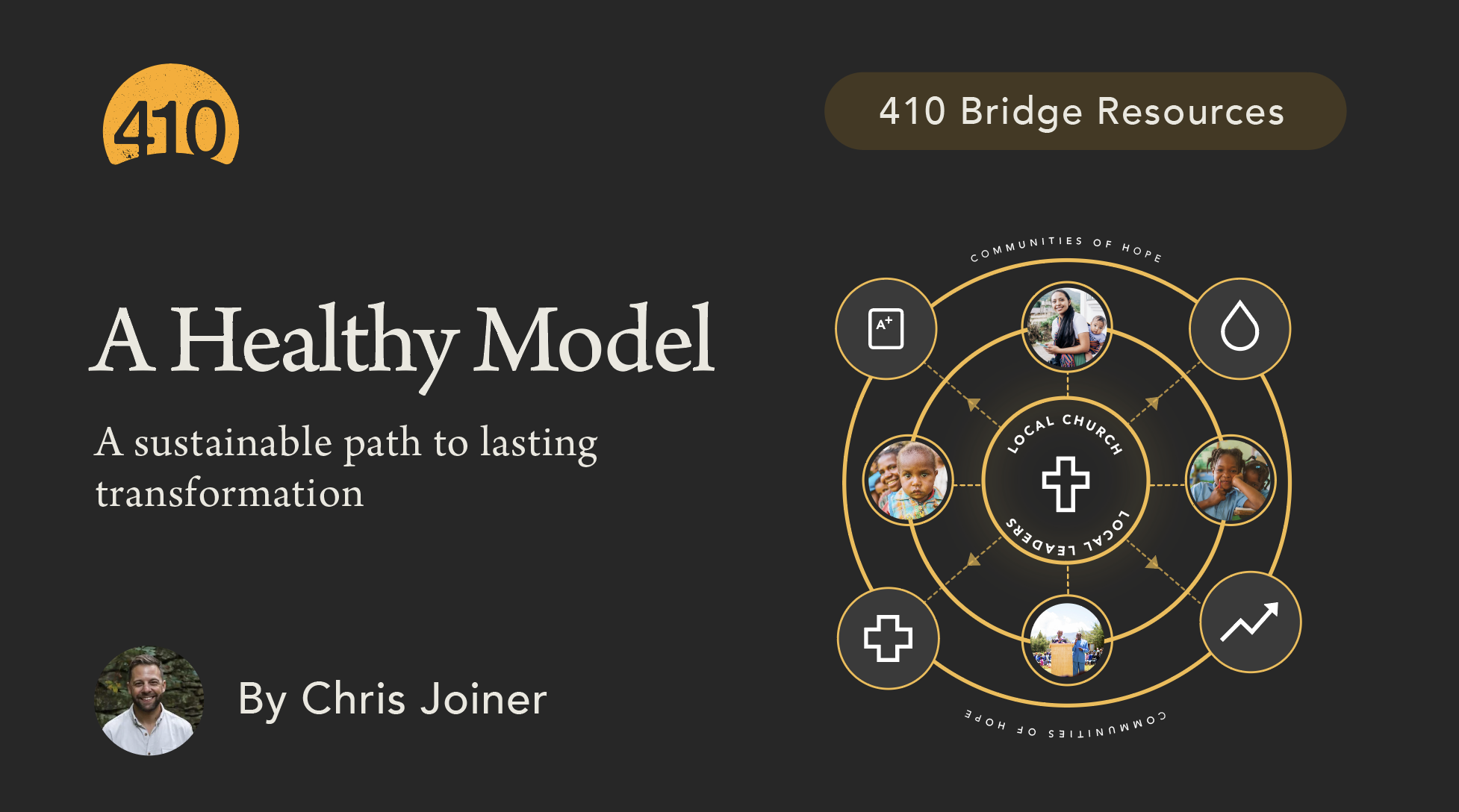
While we're there, we work through a holistic model focused on five areas: education, spiritual growth, clean water, health, and economic development. But these programs aren't the destination. They're tools designed to help a community build the capacity to thrive from within.
At the center of that work are the local church and local leadership.
We believe sustainable transformation has to be locally led. The local church provides spiritual leadership, discipleship, and a lasting presence in the community. Local leaders bring the relationships, knowledge, influence, and ownership needed to move their community forward.
They know their community in ways we never will. And they will still be there long after 410 Bridge is gone.
Over the years, we've learned that it's possible to produce a lot of activity without producing lasting transformation.
More projects don't necessarily mean more impact. More programs don't necessarily mean greater ownership. And bigger doesn't always mean healthier.
So we keep coming back to one question: Is what we're doing creating greater ownership, or greater dependency?
The tipping point
Here's the part I love most.
As the local church and local leaders take greater ownership, something begins to shift. The community moves from receiving outside support to increasingly driving its own transformation.
We call this the tipping point — the moment when the center of gravity shifts and a community's momentum becomes its own.
Local leaders are leading. The local church is strengthened. Families are participating. And more and more, the community is owning the way forward.
Our role begins to change.
It's not a finish line we drag communities across. It's a threshold they cross themselves.
The goal from day one
From the day we enter a community, we're working toward a day when our presence is no longer necessary.
When a community reaches the point where its future is no longer dependent on 410 Bridge, the story moves in two directions — and both are worth celebrating.
The community continues forward — thriving from within, led by its own people, strengthened by the local church, and sustained by the capacity it has built.
And 410 Bridge steps out, carrying what we've learned into a new partnership with another community.
That's not the end of the story. It's what we hoped for from the beginning.
We measure success not by how long we stay, but by how well we leave.
Because lasting transformation is rarely built through short-term fixes. It's built through discipleship, trust, local ownership, empowerment, and relationships over time.
The goal was never for a community to depend on 410 Bridge. The goal is for that community to thrive long after we're gone.
What this means for you
I believe the future of missions will belong to churches and ministries that strengthen local churches, develop local leaders, build long-term relationships, and create ownership instead of dependency.
If that's the future you want to build toward, here's where to start.
If you lead missions at your church:
Audit your current missions calendar. For each trip or project, ask: Is this creating ownership in the community, or dependency on us? Activity and impact are not the same thing.
Ask your partners the hard question. What's the plan for this community to thrive without depending on outside help — and how will we know when it's happening?
Trade a trips mindset for a strategy mindset. Instead of asking, “Where are we going this year?” ask, “What story are we joining — and for how long?”
If you're considering a mission trip with your family:
Choose a partnership, not a destination. Look for organizations that work through local churches and local leaders and return to the same communities year after year.
Prepare your family to be guests in someone else's story. Talk before the trip about what it means to serve alongside a community rather than for it.
Plan for what happens after you land back home. The best trips change how your family lives, gives, and prays long after the plane ride.